The Timeless Art of Flexible Brass Fish
- Sumana Mukherjee
- Dec 20, 2025
- 3 min read

Updated: Dec 22, 2025

By Indrani & Soumya, Svanir Wilderness Ecostay
In our home, among all the beautiful handicrafts of Odisha like Pattachitra paintings and dokra pieces , there’s one item that always catches everyone’s eye: a 30-inch brass fish. It has delicate patterns all over it and shines even after all these years. When Soumya was a child, he loved testing its flexibility, gently bending it from side to side and watching how it swayed. Thankfully, it never broke! Today, that same fish has a new place at Svanir, after my mother- in-law decided it was time to let it go.
Our curiosity about this craft led us to a small village famous for its unique Flexible Brass Fish. This traditional art has remained the same for over a hundred years, but what fascinated us even more was the story behind it.
The village, Belaghunta, lies about two and a half hours from Gopalpur or Chilika lake. When we reached the busy town center, we called our local contact, who guided us through narrow lanes to meet the artisans still keeping this ancient craft alive.
Mr. Maharana, one of the leading craftsmen, welcomed us warmly and showed us around his simple workshop. “Every piece is made completely by hand,” he explained proudly. “Even these tools — I made them myself.” He also shared their hope for an art center where local artists could work together and complete larger orders more efficiently. “Sometimes we get big orders,” he said, “but making each piece takes a lot of time, so we can’t meet all the requests.
As we listened, he told us about the late Bhikari Maharana, a master artisan who once worked in the court of the Bhanja King. The ruler was so impressed that he gave him the title Bindhani Ratna meaning “the gem of craftsmanship” along with a copper certificate of honor. Later, the British heard about this special art and wanted to learn the technique, hoping to use it to make flexible, lightweight armor. They tried to force Bhikari’s grandson, Gangadhar Maharana, to reveal the secret to make an armour. But Gangadhar refused to teach them, unwilling to help those who might use it against his own countrymen. Torn between his duty and his conscience, he took his own life, taking with him many of the art’s secrets. Legend says Gangadhar had perfected his craft so well that some of his fish could even float and move in water, powered by a small spring device. That level of mastery was lost after his passing, though the stories still live on in Belaghunta.

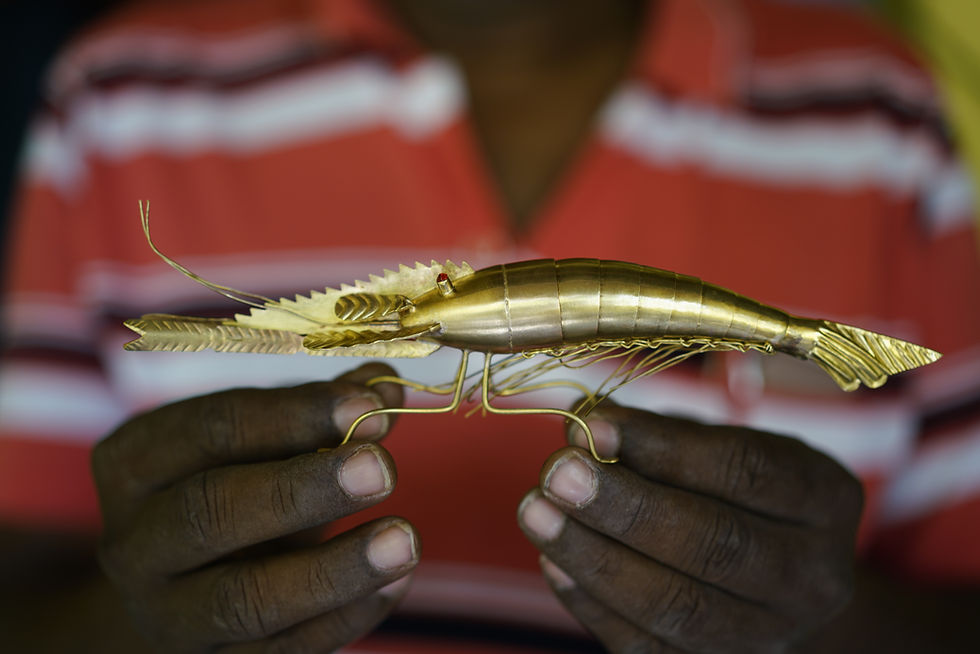
Back at the workshop, Maharana showed us how the fish are made. Each one is divided into four parts the head, upper body, lower body, and tail. The process begins with brass sheets that are cut and shaped, starting from the head. The rest of the body’s size and length depend on it. To make the fish flexible, the body is created in several segments and joined together using tiny joints, giving it that smooth, lifelike movement.
Sadly, fewer people buy these brass fish now. Plastic and steel have taken over, and the demand has dropped. Once, these fish were part of a bride’s dowry in Odisha, believed to bring good luck and prosperity. It reminded me of a similar custom in Bengal, where during Gaye Holud ceremonies, the groom’s family sends a large decorated Rohu fish to the bride dressed up in a silk saree and jewelry to symbolize blessings for a happy married life. Maharana mentioned that they now also make flexible brass snakes, lobsters, prawns and other designs to keep the craft alive. Before we left, we brainstormed a few new product ideas with him, hoping they might spark fresh opportunities.
To order directly from them please contact : Braja Kishor Maharana +91 99375 59144


Comments