When the Story Became the Last Thing We Remembered to Tell
- Sumana Mukherjee
- Apr 12
- 6 min read


Someone's grandmother kept her magazines in a specific drawer. Organised by month, sometimes by mood. She would pull one out the way someone else might pull out a letter — with the full expectation that something inside it was written for her, that it would ask something of her, that it would take her somewhere she had not yet been that week. The magazine was correspondence. Between a world out there and a person sitting inside her own life, genuinely curious about the distance between the two.
That relationship — between a reader and a publication that believed it had something worth saying at length — was built on a particular kind of mutual trust. The writer trusted the reader to stay. The reader trusted the writer to make staying worthwhile. And somewhere in that exchange, a person was being taken, slowly and willingly, into a world that was not their own, and being given enough time inside it to actually feel something about it.

A single issue could move between a profile of a weaver in Rajasthan, a long wandering reflection on slow travel, and a photograph spread so considered in its composition that it added a third meaning to everything the words had already built. The text and image existed in real conversation with each other — one illuminating the other, both in service of something larger than either alone.
What made all of that possible was a single, underrated thing — time. The time the writer was given to go explore. The time the reader gifted in return. And the time the magazine itself held open — like a door left ajar — between one world and another.
Then, gradually, almost without anyone announcing it, the texts grew shorter. The photographs grew larger. The headlines grew louder, more urgent, engineered to stop you in your tracks rather than invite you through a door. The essays that once ran across pages contracted into captions. The nuance that once gave a story its full weight was exchanged, piece by piece, for immediacy and impact — for a surface brightness that communicates everything it needs to in a single glance.
To call this a loss would be too simple, and honestly, too unfair. Because what arrived alongside this shift was something genuinely powerful — visual storytelling at a scale and reach the world had never seen before. Photography has always been capable of carrying entire civilisations in a single frame. A well-composed image can communicate grief, beauty, injustice, and wonder in ways that need no translation at all. When platforms built entirely on visual exchange gave this capacity a global reach, the results were real and meaningful — artisans found audiences across geographies they had never physically entered, communities formed around shared values, causes found witnesses who would otherwise have looked away. The image became, more fully than ever before, a language that belonged to everyone.

And yet. There is a distinction — between a story that is accompanied by an image and an image that is accompanied by a story. A magazine, at its most considered, understood this distinction and held it with conviction. The photograph was the door. The writing was the room you entered once you stepped through it. And what a room it could be — full of contradiction and context, of voices speaking at length about what they had witnessed and what they were still trying to make sense of, of the kind of layered complexity that only language, given enough space, can build.
"There are people who observe the world through images and there are people who understand the world through texts. And the best part of a magazine is that it can host both. But with the scrollability factor dominating every visible aspect of our lives, we are forgetting the most essential part of storytelling — which is the story itself." - Sumana, Editor Kriti Magazine, Founder Sustainaverse.
This feels like the most honest way to hold what has happened. Scrollability as a principle is structurally indifferent to depth — it moves whether or not the reader has finished reading, whether a thought has landed fully or simply passed through. It rewards velocity and visual impact above everything else, which means that anything competing for survival within a scrollable environment faces a steady, accumulating pressure in one direction — shorter, brighter, more immediately arresting. A magazine page, by contrast, sat still. It waited. With the patience of something that already knew its own worth.
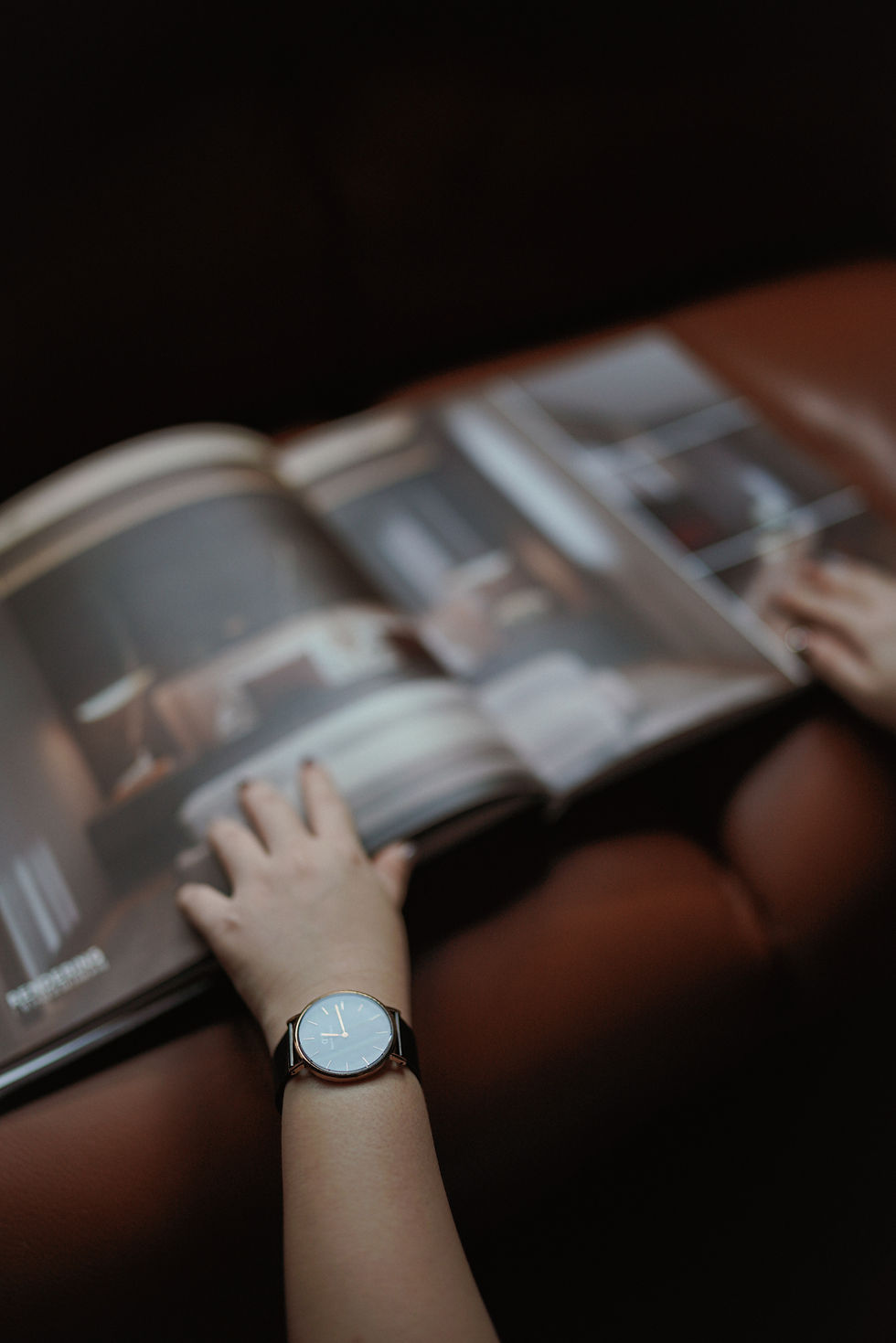
The more interesting question — and it is worth sitting with genuinely, without looking for someone to blame — is what a magazine truly exists to do. If it is primarily a visual object, its drift toward image-heaviness follows a certain logic. But if a magazine is primarily a document of the world — a record of lives, crafts, ideas, people, places, and the full irreducible texture of being human — then the written word is so far from being optional that removing it begins to feel less like editing and more like hollowing out. Documentation requires language. A photograph shows a weaver at her loom. A long, considered narrative about that same weaver tells you what she is thinking during those hours, what her grandmother taught her about tension and thread, what she fears for her craft, what she hopes for her daughter. Both are true. Both are necessary. But they accomplish such fundamentally different things that to treat them as substitutes for each other is a kind of well-intentioned forgetting.
The rise of social media as the dominant mode of how we consume culture introduced the endless, always-refreshing stream. A social media feed has no editor shaping the sequence, no spine holding it together, no final page that tells the reader something complete has been received. It is — and this is both a beautiful and slightly melancholy image — a brook that flows with complete indifference to whoever is standing at its bank, and for however long, and with whatever they were hoping to hold. A thought appears, vivid and striking, perhaps urgent, perhaps deeply personal. The stream carries it forward, replaces it immediately with something of equal brightness and equal velocity, and the first thought dissolves before the reader has had a chance to decide how they feel about it.
To follow a person's interior life through a succession of such moments is to experience their presence — and there is genuine, real value in that. But presence is the beginning of understanding, not its destination. Understanding requires duration. It requires staying inside complexity long enough for its contours to emerge, for the reader to find themselves somewhere within it. It requires the kind of sustained attention that long-form writing cultivates almost by default — because to read at depth is itself a practice of patience, and patience is what makes comprehension more than recognition.
When a magazine begins to orient itself primarily around how it will look on a grid — how its cover translates into a square, how its headlines function as standalone captions — it starts optimising for an existence that lives almost entirely outside itself. It becomes a producer of fragments meant to circulate in an environment built for fragments, and somewhere in that process, it risks losing the most powerful thing it has ever been — a complete world, patient enough and generous enough to take a reader somewhere new and hold them there long enough for something to change in them.

This is the difference between documentation and content. To document a story is to believe, without compromise, that the story deserves to be preserved whole — that the person at its centre deserves more than a caption, that the culture being written about deserves more than eleven slides, that the reader deserves more than a brilliant hook that opens into nothing. Documentation is an act of respect — toward the subject, toward the reader, and toward the conviction that some things in this world are worth recording with care and with the full weight of language behind them.
There are magazines — still publishing, some in print, some in long-form digital spaces that have held carefully onto what they are — that carry this forward as both practice and belief. They still trust readers to follow an essay across many pages. They still hold, against considerable pressure, to the idea that depth is something a reader will choose when genuinely offered it, and will carry with them long after the scroll has moved on.
And that appetite — for whole stories, patient stories, stories that leave something behind in the reader that was not there before — has never actually gone anywhere. It has simply been underserved. Every time someone finishes a long piece of writing and feels, without quite intending to, that the world has become a little more legible to them, that is the reader remembering what reading, at its best, has always been able to do.
Magazines, at their most essential, were never about what they looked like. They were about what they left behind in you — the questions they opened that stayed open long after you set them down on the table and walked back into your afternoon.
Do you find yourself searching for longer, richer stories in the publications you follow — and what do you think it would take for magazines, in print or digital form, to fully reclaim the art of telling them? We would love to hear your thoughts in the comments below :)
Lifestyle and Cosmos Blog by Sustainaverse explores ideas across sustainable fashion, conscious living, digital wellness, entrepreneurship, and the space economy. Sign up free to Lifestyle and Cosmos Newsletter


Comments